

29 stencils and pieces of graffiti from the gritty streets of Bogotá, Colombia, are now available here for your eyes. Read more about the Border Crossings-project in the earlier post.
Showing posts with label photography. Show all posts
Showing posts with label photography. Show all posts
Monday, July 28, 2008
Border Crossings: Bogotá
Wednesday, June 4, 2008
The Color Trilogy

The Color Trilogy is a short photo essay on the Bolivarian revolution-movement in Venezuela. It's a small trip into Hugo Chavez´s bizarre mixture of furious nationalism, militant populism, erosion of democracy, dreams of La Gran Colombia, fancy for old-fashioned communism - and perhaps, on the bottom of it, a bit of genuine social progress.
Simon Bolivar was a legendary figure in South America's independence struggle, highly admired in every Spanish-speaking part of the continent and made into something of a figurehead by Chavez for his government. Bolivar can be seen revered in Venezuela along with the characters such as Ernesto Guevara and Fidel Castro. Worth noting is also the resurrection of Bolivar's plans of La Gran Columbia, a union of Ecuador, Colombia and Venezuela. Illustrating the shared history of the three countries, the same three colors are shared by the almost identical flags of the three.
View The Color Trilogy as a slideshow.
Thursday, May 8, 2008
The Sky Above Bogotá
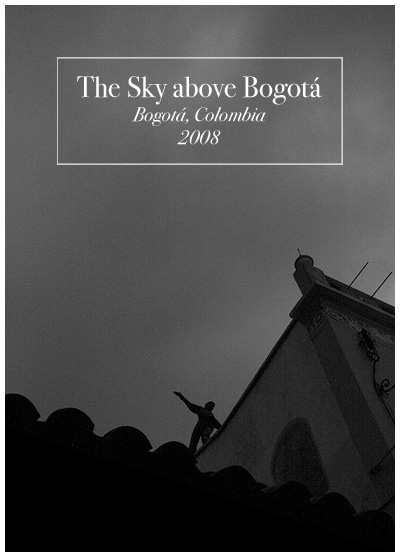
The Sky Above Bogotá is a photo essay about Bogotá. It's a story about wind-beaten walls, asphalt shining in the rain and a grey sky. It´s a story about soldiers and old men, metal-fans and teenage-girls, criples and homeless people and many, many others. It's a story about pigeons, books and angels.
View The Sky Above Bogotá as a slideshow.
Wednesday, March 12, 2008
The Divided City I
"Exite o Rio de Janeiro, o Rio de Janeiro e o Rio de Janeiro. Três cidades que occupam o mesmo espaçi geográfico, mas raramente o mesmo espaço simbólico." -Silvio Essinger: Batidão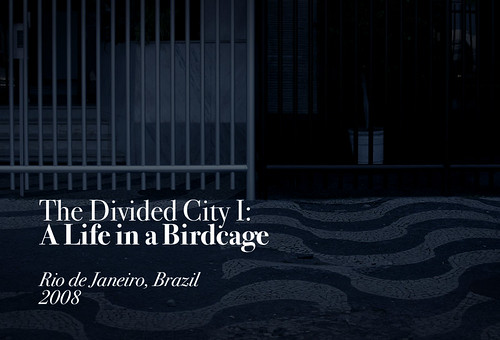
Rio de Janeiro is a divided city, as is every third world metropolis. But Rio is divided in a unique way, because of the geography of the city. The city is a mosaic of the sea and the city, the hills and the rainforests, a labyrinth of the asphalt and the unpaved paths.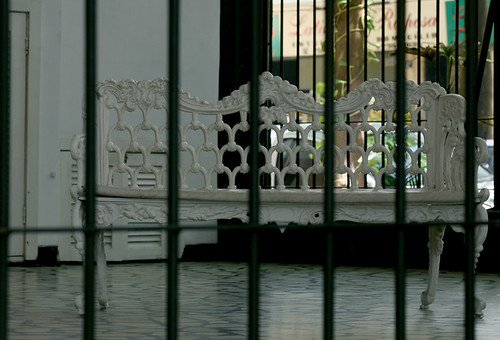
The poor in Rio live right next to the rich. They haven't been pushed to the fringes of the city, which would be the usual solution to get the slums out of sight and out of mind, nor has the middle-class fled to seek refuge in the suburbs, as is the case in the North American cities. The poor have built their favelas on the hills overlooking the richer neighbourhoods.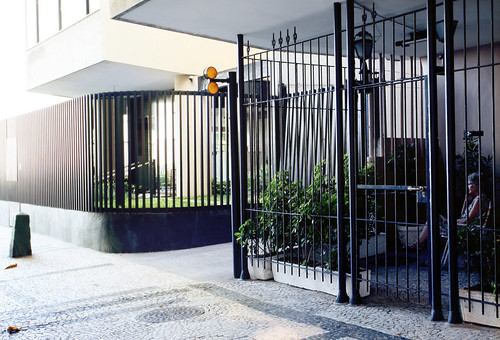
Such proximity evokes fear in the rich. Poverty and social problems breed violence and Rio has plenty of both. The media is happy to pour gas into the flames. News of murders, robberies, kidnappings and car highjackings. The rich are caging themselves in, seeking protection from the dangers real and imagined.
This is the first Rio, a city of metal bars, locks and private security. A city of door-men, red carpets and refridged, freezing air. A city hidden by behind the darkened windows and bullet proof glass. A city of birdcages.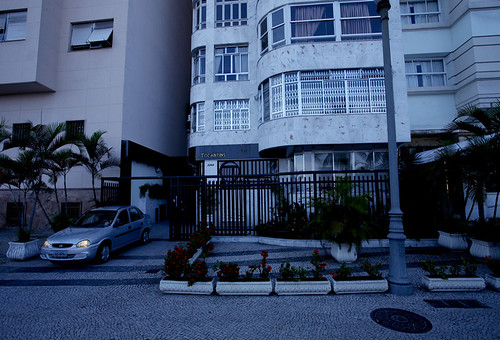
I had planned to file these images in my Flickr under a collection called Photo reportages. But it sounded too pompous, as professional photo journalism these pictures are not. They move somewhere between pure artistic expression and an attempt at a social documentary, yet I do try to convey an honest (if somewhat personal) image of the issues tackled. I ended up naming the collection Photo essays. Maybe that would be more accurate. First "essay", The Divided City, is about the social divide in Rio de Janeiro and I just got the part one - A Life in a Birdcage - on-line. Please follow the link below to see all the images in their proper size and order. The second part "A View to the Sea", on life in the favela of Babilônia, will hopefully soon follow.
View A Life in a Birdcage as a slideshow.
Thursday, February 7, 2008
Out of the white box and into the streets
They come out at night, each evening travelling all the long miles from the suburbs. After the sunset they start their work, in the shadows of the proud new highrise projects that stand against the night sky. The cartoneros. They go through the trash - your trash - piled on the street in big, black plastic bags. Looking for something worth selling. Cardboard, mostly. Sometimes you still see them in the light of the morning, pushing their huge carts full of cardboard. What they do to this trash, you don't really even think about.
And after a while you pay less attention to them than you would pay to rats. Rats - or cockroaches - at least give you that disgusted shiver every time. These people, dressed in grey rags, seem to melt into concrete walls behind them, like chameleons. And stepping over the homeless people sleeping on the streets becomes your second nature. As disgusting as it sounds, it's what this divided metropolis does to you. There's one Buenos Aires that is booming, and then there is one living in the shadow of it. One you would like to forget about, as you go on enjoying your lavish lifestyle.
This is what the economic crash of 2001 did to Buenos Aires, the city once proud of it's big middle class and relative economic equality. A new city was born around it. A shadow city, that still is there, despite the middle class slowly recovering from the crash. It's right there, out on the streets below - and also inside the grandiose apartments in glassy skyscrapers, it's there, in the cramped rooms of the maids most of the middle class families employ. You just need to start seeing it again. Or it will never go away. 
The unconfortable process of opening your eyes
"You see plans for apartments of 300 square meters and the dependencia (maid's room) is two-by-two. Son of a bitch. With 300 square meters, don’t you think you could offer something a little better?" That was the photographer Sebastián Friedman (b. 1973, Argentina), commenting on his project Domésticas in an interview by Wicked BA (available on-line on pages of Whats Up Buenos Aires). Friedman has taken as his job to point out the existence of this conciously forgotten city, and judging from the waves he's been making, he's doing a pretty good job.
In Domésticas Friedman exhibited portraits of families together with their maid - creating a strangly uncomfortable images - in Biblioteca Nacional, and even built a fully furnished maid's room on location to illustrate cramped conditions the domestic servants live in.
And in second exhibition, Friedman took the photographs of the carteros out of gallery and exhibited them in their natural environment. Show was held in a partly ruined factory in rundown suburb of Lanús. This was the place the cartoneros actually used to sell their nightly lootings. Friedman wanted to show this space and the actual reality to the people willing to see the exhibition. They had to step out of the safety of a gallery, to a place full of trash, where the cartoneros would be working while spectators were looking at the photos. "To smell the odors that there were in the space, see the cartoneros, it creates a space that’s not so secure", explained the photographer his ideas.
Give it back to the people you took it from
Currently there is another, a bit less grim exhibition hitting the streets of Buenos Aires. Award-winning Project YECA, by photographer Luis Abadi (b.1975, Argentina), is exhibited outside Edificio de la Administración de Parques Nacionales (Av. Santa Fe 690, Retiro), open for all and free of charge.
On the project website, Abadi explains how he went out to streets to take pictures of people he came across and started feeling that he has to give them something back. "They lend me themselves for the picture without asking anything back. It's not fair, there has to be an exchange, I have to show them the photos." Abadi also wanted to make a comment on commercial billboards that are omnipresent in Buenos Aires by putting art into their place - art that is usually hidden from the every man in the galleries, far from the general public. 
You can browse the pictures from Proyecto Yeca on the website. Some of them are quite hilarious and create a group portrait of the melting pot of people called Buenos Aires. The good, the bad and the ugly, the bold and the beautiful, the rich and the poor and everyone between. Work men, old ladies in matching furs, nuns and businessmen, protesters and police officers, transvestites and whores, they're all there. And of course the dogs. You must not forget the dogs in Buenos Aires.
Thursday, January 31, 2008
Oscar Bony, the Magician

Museo de Arte Latinoamericano de Buenos Aires (MALBA) is the sparkly new museum of contemporary art in Buenos Aires. It exhibits an interesting collection of modern and contemporary Latin American art - including works from classic names like Antonio Berni, Diego Rivera and Frida Kahlo, but also pieces by the cream of the younger generation. Changing exhibitions feature design in addition to fine art and there are daily screenings of films from Argentina and abroad. For me, one of the high lights of the recent months' exhibitions was Oscar Bony, El Mago - the retrospective of Argentinian artist Oscar Bony (1941-2002).
Bony started out as a painter, but quickly ventured into variety of different modern art forms. His paintings literally grew into installations and sculptures, as he started experimenting with adding objects to his paintings. Bony became one of the "young rebels" of the Buenos Aires art scene, trying his hand at performances, happenings and video art, and finally focused mainly on photography.
Conceptual side was important in Bony's works through out his career. He sparked controversy with La Familia Obrera, in 1968. Bony hired a whole working class family to sit in the gallery, promising to double their hourly wage.
During the oppressive reign of the infamous military junta in Argentina, Bony among number of other artists stopped creating art for a number of years. "We undertook a fantastic utopia: unable to change society, we committed suicide", Bony later commented the resolution of his and his collegues. He then worked as a professional photographer, creating visual indentities for bands of the rock nacional-movement. He returned to the fine art in mid-70's, but soon moved to live in exile in Milan, where he actively participated the Europian art scene. Bony returned to Buenos Aires in '90s, working on photography, pictures typically framed behind a glass and then shot at with a 9 mm pistol.
There is something immensely powerful in the simple components Bony uses to construct his photographs. Often there's a picture of him, dressed in a dramatic black suit, his age clearly visible on his face. Or perhaps a faded picture of him as a young man. And there are brutal gun shot holes and shatters in the glass and the photograph behind it. Might almost sound corny, but the visual impact and certain strange ambiguity make these pictures unforgettable.

Subscribe to:
Posts (Atom)

 Posts
Posts


